Charles Avery: The Scottish Artist Behind Imaginary Worlds
Exploring Charles Avery’s Biography, Artistic Career, The Islanders Project, Achievements and Creative Legacy

Introduction
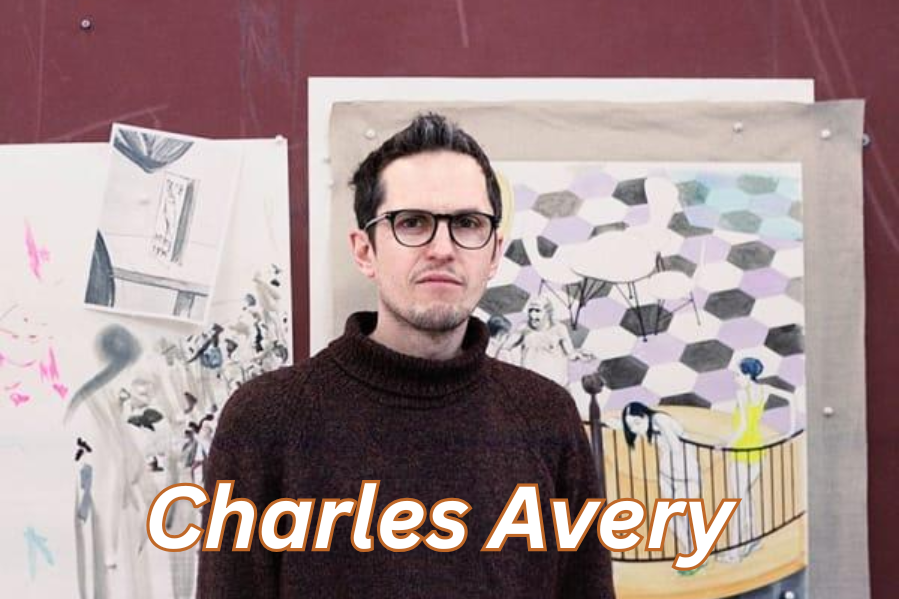
Charles Avery has spent much of his artistic career making an impossible place feel almost real. The Scottish artist became known for The Islanders, an elaborate fictional civilisation expressed through drawings, sculptures, writing and installations. Its inhabitants, cities and even its strangest inventions follow an internal logic.
His art examines how people construct knowledge, organise societies and give meaning to the unfamiliar. After two decades developing his imaginary Island, he began a striking new body of work in 2024, opening another chapter in an already distinctive career. Charles Avery Quick Biography
| Detail | Information |
|---|---|
| Full Name | Charles Avery |
| Birth Year | 1973 |
| Age | 53 years (as of 2026, depending on birthday) |
| Birthplace | Oban, Scotland |
| Nationality | Scottish / British |
| Profession | Contemporary Artist, Sculptor, Illustrator |
| Famous For | The Islanders Art Project |
| Education | Chelsea College of Art, London (Foundation Course) |
| Career Beginnings | Before 2004 |
| Major Project | The Islanders (2004–2024) |
| Recent Project | The Eidolons (2024 onwards) |
| Artistic Style | Conceptual Art, Drawing, Sculpture, Installation |
| Major Achievement | Participation in the 2007 Venice Biennale |
| Residence | London and Isle of Mull, Scotland |
| Net Worth | Not publicly verified |
| Marital Status | Not publicly confirmed |
| Children | No verified public information |
| Religion | Not publicly disclosed |
| Known Influences | Philosophy, particularly Ludwig Wittgenstein |
Who Is Charles Avery?
Born in 1973 in Oban, Scotland, Avery is a contemporary artist whose work moves between detailed figurative imagery and abstract structures. His best-known achievement is the invention of a fictional Island, a project he began in 2004 and developed across numerous exhibitions and publications.
He lives and works in London and on the Scottish Isle of Mull. The Hebrides and urban life both inform his imagery.
His artworks share conceptual worlds: a drawing can introduce a place, while a sculpture resembles an artefact brought back from it.
Early Life and Artistic Education
Avery’s upbringing in Scotland’s Inner Hebrides helped shape his sense of landscape, isolation and community. The Island’s remote terrain and social customs reflect those influences without reproducing his childhood surroundings.
He completed a foundation course at Chelsea College of Art in London and is generally described as largely self-taught. His working method instead emphasises curiosity, improvisation and sustained commitment to interconnected ideas.
Before 2004, he was already making drawings. The Islanders transformed individual explorations into an expanding universe.
The Islanders: An Artwork Without Fixed Borders
A Place With Its Own History
The Islanders is not a novel illustrated after the fact. The Island emerges through the artworks themselves, with every new image, object or text potentially changing what viewers know about it. Geography, beliefs and commerce are as important as the characters.
At its centre sits Onomatopoeia, a port city whose transformations echo familiar patterns of real urban history. It develops from a settlement for travellers and pioneers into a prosperous commercial centre, experiences hardship and eventually undergoes cultural regeneration.
Its markets and buildings suggest a city with a long past, while inviting questions about migration, power and historical memory.
The Hunter, the If’en and the Unknown
One recurring figure is the Hunter, whose journeys offer a way to investigate the Island beyond its urban centre. The Eternal Forest is associated with the elusive Noumenon.
Another important presence is the If’en, the Island’s native inhabitants. Their history introduces more unsettling subjects, including colonial violence and restrictions on movement. Avery’s 2007 drawing The Place of the Route of the If’en depicts a location tied to their persecution, showing that this imagined world is not simply an idyllic escape.
These details raise questions about who controls a place, establishes authority and records its history.
The Distinctive Style of His Drawings and Sculptures
Avery’s drawings frequently combine precise architectural description with loose, unfinished passages. Streets, crowds and curious objects are rendered convincingly, while other areas seem to dissolve into possibility. The contrast reveals the act of invention.
His methods are improvisational rather than dependent on a fully written script. Characters can emerge during drawing and influence later works.
Sculpture adds a different kind of persuasion. Strange plants, vessels and architectural forms become physical objects that visitors can walk around. Like imported artefacts, they blur the boundary between gallery and imagined place.
Works inspired by the Island’s artificial municipal gardens are especially revealing: familiar trees become improbable objects that question what people accept as natural.
The 2009–10 panoramic drawing Untitled (View of the Port at Onomatopoeia), more than five metres wide, exemplifies his ability to make a dense imaginary community feel active and inhabited.
Philosophy at the Heart of the Work
The Atomic and the Mystic
The philosopher Ludwig Wittgenstein has been particularly influential on Avery’s thinking. The artist has distinguished between an atomic approach, associated with geometry and logical structures, and a mystic approach, often expressed through figurative drawing and ambiguous narratives.
Together they expose a tension between systematic description and what resists explanation.
The Island becomes a testing ground for perception, metaphysics, mathematics and language. Its customs are unfamiliar, but the problems remain human.
How Fiction Becomes a Method of Enquiry
Ordinary maps suggest that territory can be measured and understood. Avery’s maps and drawings instead remind us that every description depends on choices, assumptions and perspective.
His work also invites viewers to reconsider the status of an artwork. A sculpture can be a real object and supposed evidence of an unreal place, a contradiction deliberately left unresolved.
Major Exhibitions and International Recognition
Avery gained significant visibility through Scotland’s presentation at the 52nd Venice Biennale in 2007. His major exhibition The Islanders: An Introduction opened at Parasol Unit in London in 2008 and travelled to the Scottish National Gallery of Modern Art in Edinburgh and Museum Boijmans Van Beuningen in Rotterdam.
A 164-page publication, The Islanders: An Introduction, accompanied the project’s 2008 presentation, providing another way to explore the fictional territory and its visual language.
He also appeared in Altermodern, the 2009 Tate Triennial at Tate Britain. These appearances brought his conceptual storytelling to international audiences.
Further milestones include The People and Things of Onomatopoeia at Edinburgh’s Ingleby Gallery in 2015, These Waters at GRIMM in New York in 2017–18, and The Gates of Onomatopoeia in Edinburgh in 2019. His work was also included in the 2019 Istanbul Biennial.
His artworks are held in major collections including Tate, the National Galleries of Scotland, the Arts Council Collection, Museum Boijmans Van Beuningen and Kunstmuseum Den Haag. Such recognition reflects his practice’s visual and conceptual ambition.
A New Direction: The Eidolons and The Eidolorama
In 2024, Avery set The Islanders aside to develop a new project known as The Eidolons. After twenty years spent on one world, he turned towards how simple shapes can generate their own relationships.
The transition appeared in GRIMM’s 2025 New York exhibition The Eidola, Pigs and Blades of the Inner Vast. Later that year, Ingleby Gallery in Edinburgh staged The Eidolorama, an exhibition of paintings whose abstract forms sometimes suggest recognisable objects without settling into fixed identities.
As of October 2026, GRIMM’s Amsterdam exhibition Where Rocco Found a Dead Monster OR The Land of the Downcast Eyes runs from 9 October to 14 November. It connects the two projects through sparse landscapes occupied by travellers, animals and enigmatic forms above the horizon.
This recent work shows continuity beneath the change in appearance. Avery remains interested in how a system of images can create its own rules and meanings, even when a crowded imaginary metropolis gives way to an almost empty landscape.
Why His Art Matters
What distinguishes Avery is the seriousness with which he treats invention. He does not merely illustrate a fictional story: he investigates what makes a fictional world persuasive and how its details can shape the way an audience thinks.
His work shows that intellectual complexity and storytelling can coexist, offering questions without prescribed answers.
Conclusion
Charles Avery has built a career around the relationship between imagination and understanding. The Islanders made him an important figure in contemporary world-building, while The Eidolons demonstrates his willingness to rethink a long-established approach.
Whether depicting a busy port or an enigmatic abstract form, he asks viewers to consider how meaning takes shape.
Frequently Asked Questions
Who Is Charles Avery?
Charles Avery is a Scottish contemporary artist born in Oban in 1973. He is best known for The Islanders, a fictional world developed through drawings, sculptures, texts and installations. His work combines visual storytelling with questions drawn from philosophy, mathematics and the study of how societies function.
What Is Charles Avery Most Famous For?
He is most closely associated with The Islanders, begun in 2004. The project centres on an unnamed imaginary Island and the port city of Onomatopoeia. Its detailed characters, architecture and history have appeared in exhibitions internationally, making the project a distinctive example of contemporary artistic world-building.
Where Did Charles Avery Study Art?
Avery studied a foundation course at Chelsea College of Art in London. The National Galleries of Scotland describes him as largely self-taught. His artistic approach is shaped by drawing and philosophical enquiry.
Where Can You See Charles Avery’s Artwork?
His work belongs to public collections including Tate and the National Galleries of Scotland, although individual pieces may not always be on display. He also exhibits through galleries such as GRIMM and Ingleby. In October 2026, a solo exhibition is running at GRIMM in Amsterdam until 14 November.
Is Charles Avery Still Working on The Islanders?
After developing The Islanders for around two decades, Avery set the project aside in 2024 and began The Eidolons. His recent paintings use simpler forms, sometimes alongside figures and landscapes that recall his earlier work. The shift does not erase the importance of The Islanders to his career.
READ THIS TOO Phil Austin: The Voice Behind Nick Danger and Firesign Theatre




One Comment